

Subscribe and receive email notifications of new blog posts.
 RSS Feed
4
Retiring to Bend, Oregon: What Strategic Buyers Need to Know
Retiring to Bend, Oregon: What Strategic Buyers Need to Know
Retiring to Bend, Oregon: healthcare, taxes, neighborhoods, and a structured framework for buyers committing to the next chapter.
Quick-Answer Callout
Retiring in Bend is a decision worth slowing down for. The city offers exceptional outdoor access, a Level II trauma center, and no sales tax. It also carries a cost of living roughly 33 percent above the national average and a high-altitude environment that takes adjustment. Strategic retirement buyers run a structured framework before they commit, not after they've already moved.
Why Bend Attracts Active Retirees
Bend has shifted from a regional mill town into one of the most consistently named retirement destinations in the Pacific Northwest. The reasons are not surprising. Close to 300 days of sun a year. The Deschutes River running through downtown. Mount Bachelor 22 miles southwest for skiing. The Cascade Lakes Highway for summer hiking and paddling. The Old Mill District for restaurants, walking paths, and live music. A Level II trauma center at St Charles Medical Center.
For retirees who define their next chapter around outdoor access, intellectual community, and a calmer pace than a coastal city, Bend lands.
What Strategic Retirement Buyers Look at Before They Commit
Retirement is the highest-stakes life transition most people make. The decision shapes the next twenty to thirty years. Strategic buyers run a Lifestyle Alignment Scorecard before they commit, weighted heavily on the priorities that matter in retirement specifically.
1. Healthcare Access
St Charles Medical Center is the largest hospital in Central Oregon and the only Level II trauma center in the region. Cardiology, orthopedics, oncology, and emergency care are available locally. For specialized care beyond St Charles, the closest major academic medical centers are in Portland (a three-hour drive) or Seattle.
Strategic buyers map their current and likely future healthcare needs against what's available locally. Then they choose a neighborhood with that travel pattern in mind.

2. Tax and Financial Implications
Oregon has no sales tax, which is a meaningful saving on big-ticket purchases. Social Security is not taxed at the state level. Most other retirement income (pensions, 401(k) withdrawals, IRA distributions) is taxed at up to 9.9 percent depending on income.
Strategic retirement buyers run the numbers on their specific income mix before they assume Oregon is automatically tax-friendly.
3. Altitude Adjustment
Bend sits at 3,623 feet. Buyers relocating from sea level often experience headaches, dehydration, fatigue, and faster effects from alcohol for the first two to four weeks. Retirees with cardiovascular conditions or high blood pressure should discuss the altitude shift with their physician before committing.
4. Snow and Winter Mobility
Bend gets roughly 32 inches of snow per year, distributed unevenly across quadrants. The west side gets more. The east side gets less. Mountain pass driving requires chains or traction tires legally during winter months. Strategic retirement buyers think clearly about whether they want to drive in snow at 75.
5. Community Fit
Bend has a younger active-retiree population than most retirement destinations. The default community is mixed-age, not age-restricted. For retirees who want a 55-plus community, Bend has options, and for retirees who want to live alongside families and professionals, the standard Bend neighborhoods deliver that mix.
Neighborhoods That Suit Active Retirees
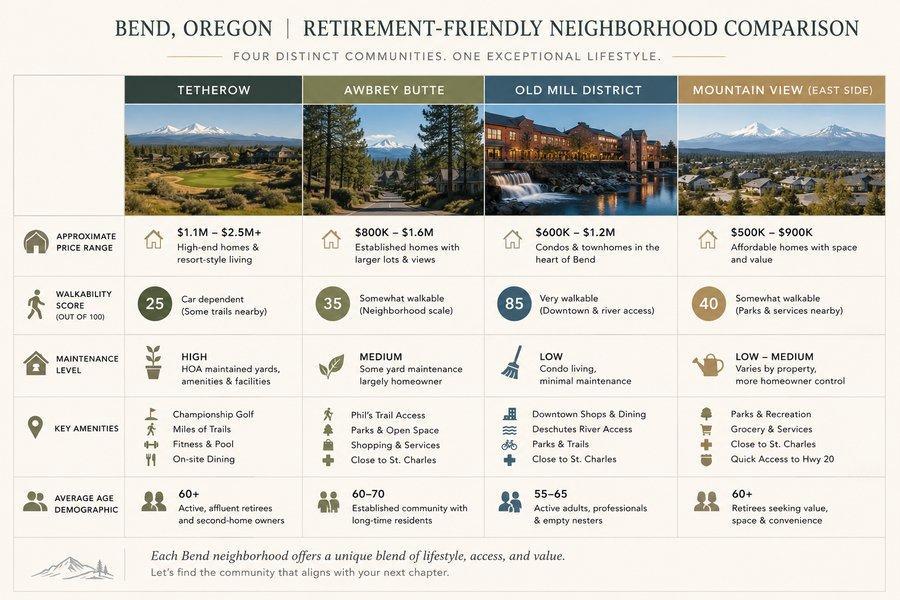
Tetherow offers a luxury golf community with maintenance-included townhome options and full resort amenities. Higher price point.
Awbrey Butte and Awbrey Glen offer scenic views, established homes, and proximity to Northwest Bend's outdoor access. Quieter, more private.
The Old Mill District and Old Bend offer walkable downtown access, the Deschutes River Trail, and restaurants. Strong fit for retirees who want to walk to coffee.
East-side neighborhoods near St Charles (Mountain View, Boyd Acres, the Orchard District) offer healthcare proximity that matters for retirees prioritizing access to St Charles Medical Center. Lower price band than Northwest options.
What Most Retirement Buyers Underestimate
The Stairs Question
A three-story Tetherow home looks great at 67. It looks different at 78. Strategic retirement buyers ask directly whether the home they're buying is the home they'll still want to live in across the next two decades.
The Visiting-Family Capacity Question
Some retirees underestimate how often family visits when the destination is Bend. Others overestimate it. Either error has cost implications.
The Long-Term Maintenance Question
Acreage in the southeast quadrant looks beautiful. It also requires more maintenance than a townhome. Buyers who underweight maintenance burden find themselves hiring out at year five for tasks they assumed they'd do themselves.
Frequently Asked Questions
Is Bend a good place to retire if I don't ski?
Yes. Hiking, paddling, golf, road biking, mountain biking, and the Old Mill District restaurant and arts scene serve retirees who never put on skis. Skiing is a bonus, not a prerequisite.
How does Bend compare to Sisters or Sunriver for retirement?
Sisters offers a quieter pace and strong small-town identity, with limited inventory and longer drives to healthcare. Sunriver offers resort-style living with HOA-managed infrastructure. Bend offers the most amenities, the most healthcare access, and the largest community.
What's the cost-of-living premium relative to the national average?
Roughly 33 percent above the national average overall, with housing closer to double the national norm. The no-sales-tax advantage offsets some of the housing premium. The income tax does not.
Do I need a 4-wheel-drive vehicle for Bend winters?
In-town driving is manageable with good tires for most retirees. Mountain pass driving requires chains or traction tires by Oregon law during posted winter months.
How much should I budget for the altitude adjustment?
Plan for two to four weeks of dehydration, possible headaches, and lower alcohol tolerance. Increase water intake substantially. Consult your physician before relocating if you have cardiovascular or pulmonary conditions.
When You're Ready to Run Your Retirement Scorecard
Retiring to Bend is one of the most consequential decisions of the next chapter. The Strategic Relocation Blueprint is built for buyers who want a structured framework before they commit. Reach out at lsnider@authenticus.us or 503-592-4323.
Privacy Policy / DMCA Notice / ADA Accessibility


